A shared basis for responsible AI use in COI: the ACUTE guidelines
The ACUTE project has published an analysis of the legal, methodological and ethical constraints on using AI in COI, alongside guidelines for its responsible use. Agreed by all project partners, the guidelines provide a common reference point for ACUTE’s further work.
The ACUTE project's third deliverable is titled "Constraints Analysis & Ethical Guidelines: Legal, Methodological and Ethical Constraints on the Use of Artificial Intelligence in COI". It was written by Dr. Ludivine Stewart of the University of Luxembourg Institute for Digital Ethics (ULIDE) in close cooperation with the ACUTE project partners. ACCORD has previously highlighted the value of ethical guidelines written for the COI context, rather than adapted from general debates about AI. Deliverable 3 sets out to provide such guidelines.
The agreement of all project partners gives the document particular weight: Deliverable 3 now presents the current shared position of the ACUTE partners on the responsible use of AI in COI, rather than the position of a single organisation.
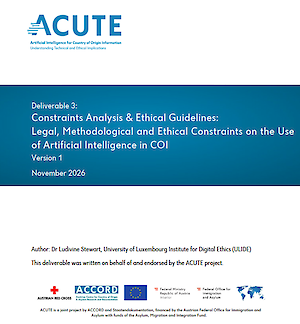
Scope & content of the ACUTE guidelines
The guidelines are addressed to organisations and individuals conducting COI research and producing COI, whether that research is done by specialised COI practitioners or by COI users such as decision-makers, judges, their staff or legal representatives. They do not address the use of AI to assess individual applications, prepare legal arguments, recommend outcomes or otherwise support the decision-making process itself.
The document has two parts. The first maps the constraints: legal (EU asylum law, the AI Act, data protection law, the Council of Europe Framework Convention on AI, and national requirements such as copyright), methodological (established COI quality standards, hallucination and bias, meaningful rather than symbolic human oversight, and the risk of losing competencies) and ethical, where the analysis is guided by four principles: accountability, continuous human oversight, technical robustness and safety, and transparency in AI usage. The second part translates this analysis into guidelines for organisations and individual practitioners. For organisations, these cover governance and research policy, tool selection, legal compliance, quality and security, transparency, AI literacy and training. For practitioners, they address accountability, attentive and legally compliant use, disclosure, and meaningful human oversight.
The guidelines are not set out to establish binding rules, but to offer a common basis that each COI unit can build on in its own workflows, from an internal AI policy to a research protocol or a training session.
Much of the legal framework is still taking shape: updated versions of the deliverable are therefore planned.
Project context & next steps
Deliverable 3 builds on the project’s earlier work: Deliverable 1 on existing AI activities and the needs and requirements for integrating AI into COI; Deliverable 2.1 on use cases tested, implemented or planned in COI units; and Deliverable 2.2 on technological approaches and recommendations for responsible use. The document prepares the ground for the next steps in the project: the development of concrete applications, a manual and training materials.
- Stewart, Ludivine (University of Luxembourg Institute for Digital Ethics): ACUTE Deliverable 3: Constraints Analysis & Ethical Guidelines: Legal, Methodological and Ethical Constraints on the Use of Artificial Intelligence in COI; Version 1, November 2026
https://www.ecoi.net/acute/acute_constraints_analysis_and_ethical_guidelines_on_using_ai_in_coi_2026-11_deliverable_3_v1.pdf
© CC BY-NC-ND
The ACUTE project aims to contribute to a common approach and help shape practical guidance for the responsible use of AI in the field of COI. We invite readers interested in COI, AI and responsible innovation to explore the publication and to follow the project’s work in the years ahead. You can read a project description on ACUTE here.