Le nouveau rapport de Cartooning for peace "Sous pression" se fixe pour objectif de dresser un état des lieux de la situation des dessinateurs de presse menacés au cours des deux dernières années, tout en formulant des recommandations visant à renforcer leur protection. RSF est partenaire et a notamment rédigé un article sur la situation des dessinateurs et dessinatrices de presse au Moyen-Orient.
In the Middle East, the absurdity is sometimes beyond words. Take Saudi Arabia, for instance: in 2018, the kingdom arrested cartoonist Mohammed Al Ghamdi, known by his pen name Mohammed Al Hazza, for publishing cartoons in the Qatari newspaper Lusail. The Saudi regime accused him, among other things, of “sympathising with Qatar”. At the time, the emirate was subject to an economic embargo imposed by Saudi Arabia. The crisis has since been resolved, however. Not only was the blockade lifted in 2021, but the two countries also signed cooperation agreements in 2025, sealing relations that are now stronger than ever. Yet in January 2025, the kingdom decided to extend Mohammed’s imprisonment, stretching his total sentence to twenty-three years in prison.
This, of course, is entirely unjust: depriving a man of his freedom for drawing a picture. But it is also absurd, since the charges against him, already highly fallacious, have now been emptied of their substance. Yet, as many cartoonists know, injustice and absurdity often go hand in hand. The abolition of logic and reason is often the corollary to the abolition of freedom. That is why propaganda, particularly in the Middle East, frequently aims to “complexify” the narrative and justify repression. Editorial and political cartoonists are an antidote to this complexity. With a few strokes of the pen, sometimes a few colours, they challenge the authoritarian regimes that saturate the public space with their narratives.
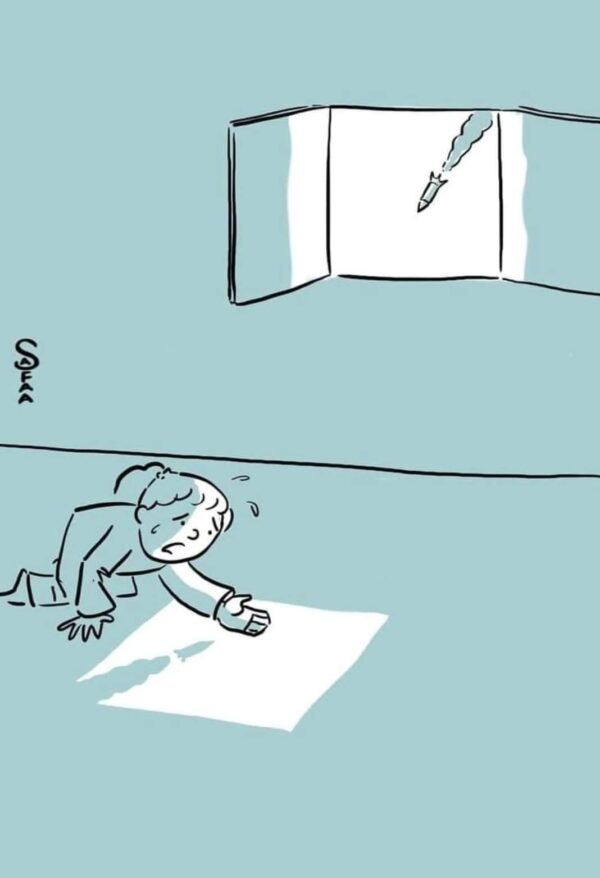
Cartoonists are resisting, however. In Gaza, for instance, political cartoons drawn by Palestinian cartoonists, which they manage to distribute internationally, counteract the Israeli government’s propaganda that seeks to obscure basic facts and repress the work of anyone who can provide evidence of an ongoing genocide. Day and night, disinformation and violence by the Israeli army hamper the work of journalists in the enclave. Almost 220 of them have been killed in the past two years, including at least 67 in the course of their work, as Reporters Without Borders was able to demonstrate. In October 2024, Palestinian cartoonist Mahasen al-Khateeb was killed in an Israeli army bombing raid. With a few strokes of her pencil, cartoonist Safaa Odah was able to pierce the “complexity” fabricated by Israeli propaganda. Her drawing of a child trying to stop the shadow of a missile hurtling towards his open window with his hand says it all: “The children of Gaza are terrified and defenceless.” It’s simple. It’s obvious. But like her fellow cartoonists on the ground, Safaa Odah herself is being punished by the absurdity of the violence she depicts: starved, forcibly displaced, she remains a prisoner in an area cut off from the world for over two years. Despite the blockade, her cartoon restores reason to the international community at a time when Netanyahu’s government is seeking to portray the victims as aggressors.
Cartoonists are intimately acquainted with these reversals of meaning. Ashraf Omar, for instance, is not a “terrorist”, he’s a cartoonist for the independent Egyptian media outlet Al Manassa. One of his latest cartoons shows a man pouring fuel on the fire of the Egyptian debt crisis in 2024, surprised that the fire was not going out. A few hours after its publication, he was arrested by Egyptian security forces and charged, without trial, with “belonging to a terrorist organisation”. Once again, absurdity reigns: Abdel-Fattah al-Sisi’s dictatorship, which continues to hold him in detention to this day, based its legitimacy on the Rabaa massacre – the deadliest attack on civilians in Egypt’s recent history. To date, 20 journalists are being arbitrarily detained by the regime because of their profession.
Why are dictators and war criminals so afraid of cartoonists? Why did cartoonist Emad Hajjaj receive threats in Jordan in 2023 for his cartoons about Gaza? Why is the Iranian regime persecuting cartoonist Atena Farghadani, who was arrested, assaulted and threatened in 2024 for a simple cartoon? For the same reason, no doubt, that they fear journalists: because their work cuts through the complexity and reveals simple truths. Because their art informs.
But there’s another reason. For decades in Syria under the Assad regime, depicting the dictator was forbidden. One day, Ali Ferzat, an iconic Syrian cartoonist, well aware of the absurdity of this decree, drew Bashar al-Assad for the first time. It was shortly after the start of the Arab Spring in 2011. One night, as he left his office, he was followed by a group of men who blindfolded him, tied him up, and then beat him unconscious. “Break his hands so he can never draw again,” he heard them say. Ali Ferzat continued to draw, including after the dictator’s fall in 2024. He knows that cartoonists are feared because they can destroy icons. They strip them of their divine aura and give people permission to mock them. “We bridge the gap between fear and hope,” Ali Ferzat said in an interview published by The Guardian in 2014. In 2025, this statement has never been truer – and cartoons have never been more necessary.
By Jonathan Dagher, head of RSF's Middle East Desk